When you specify high‑grade electrical steel for a motor, you expect low core loss, quiet operation, and consistent performance. But if the laminations are not annealed correctly after stamping, a large part of that performance is simply left on the table.
This explainer walks through annealing motor laminations in practical, OEM‑friendly terms: what annealing does to electrical steel, how it affects core losses, noise and efficiency, and what you should specify to your suppliers to get repeatable results.
We focus on industrial and appliance motors (single phase induction, shaded pole, BLDC, universal), where tight control of lamination quality, heat treatment, and testing can significantly improve lifetime efficiency and reliability.
What is annealing of motor laminations?
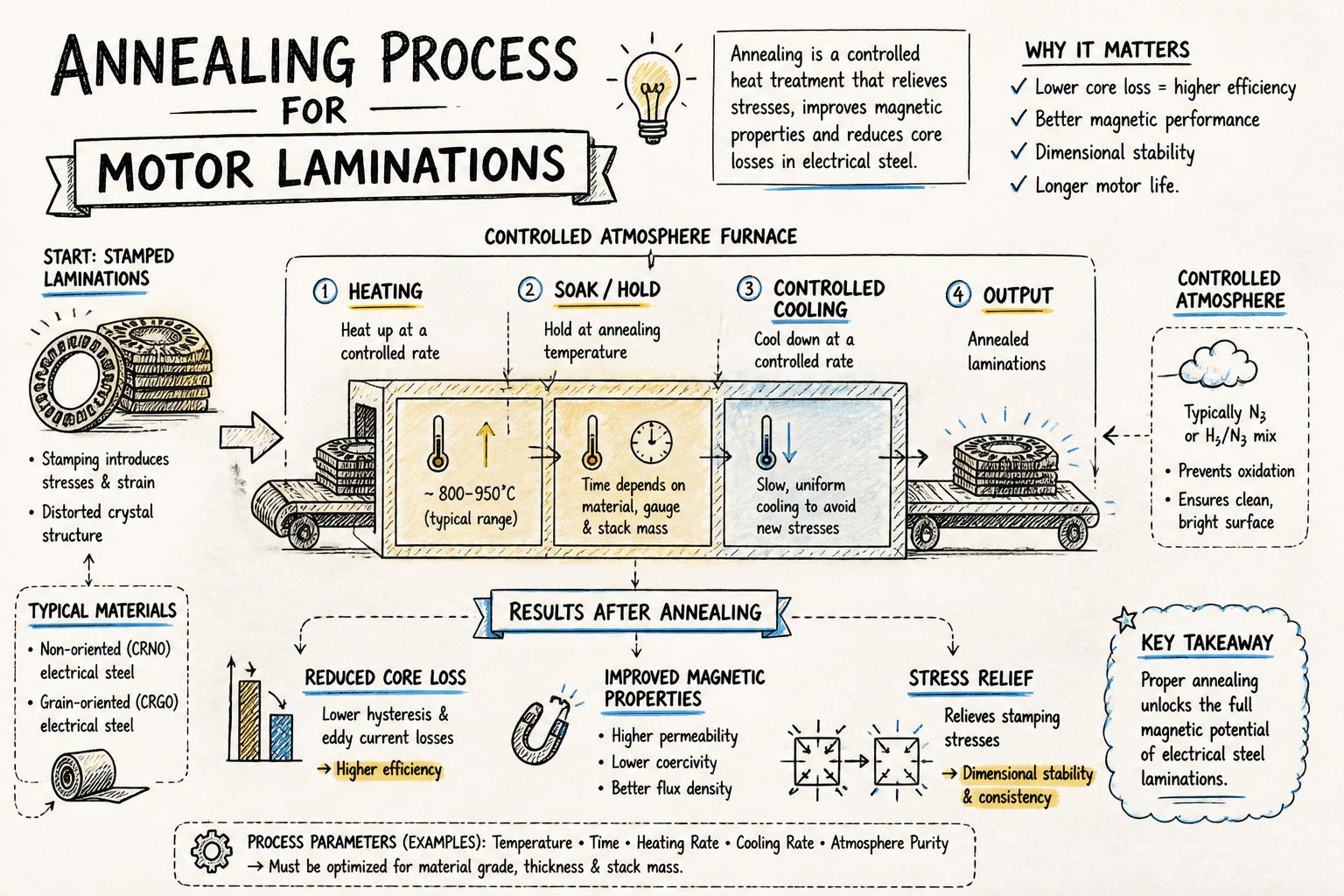
Annealing is a controlled heat treatment of electrical steel laminations carried out after stamping and stacking. The goal is to:
Restore the magnetic properties damaged during punching and blanking
Relieve internal mechanical stresses in the steel
Reduce hysteresis and eddy current losses (overall core loss)
Stabilize dimensions and flatness of laminations or stator stacks
In practice, annealing motor laminations means heating the stamped laminations or assembled cores to a specified temperature (often 750–850 °C for non‑oriented electrical steel), holding them there for a controlled time, and then cooling them in a controlled atmosphere to prevent oxidation and insulation damage.
Why stamping damages magnetic properties
Electrical steel from the mill is usually supplied in an annealed, optimized condition with guaranteed core loss values. During stamping, several things happen that degrade these properties:
Plastic deformation at the cut edge introduces residual stresses and dislocations in the crystal lattice.
Micro‑cracks and burrs at the edges disturb magnetic flux paths.
Local heating from high‑speed punching can modify the microstructure.
Stacking and interlocking operations introduce further stress and distortion.
The result is higher hysteresis loss, increased magnetizing current, and often more acoustic noise. The higher the stamping speed, tonnage, and complexity of the lamination geometry, the more pronounced these effects can be.
Proper electrical steel heat treatment reverses much of the damage caused by stamping. At the microstructural level, annealing:
Allows stress relaxation and rearrangement of dislocations
Promotes grain growth and realignment towards lower energy orientations
Reduces coercivity, lowering hysteresis loss
Improves permeability, so the core magnetizes more easily
Macroscopically, annealed laminations exhibit:
Lower total core loss (W/kg) at the specified test flux density and frequency
Lower magnetizing current for the same voltage
Reduced temperature rise during operation
Less vibration and audible noise
Key benefits of annealing motor laminations for OEMs
1. Core loss reduction and efficiency gains
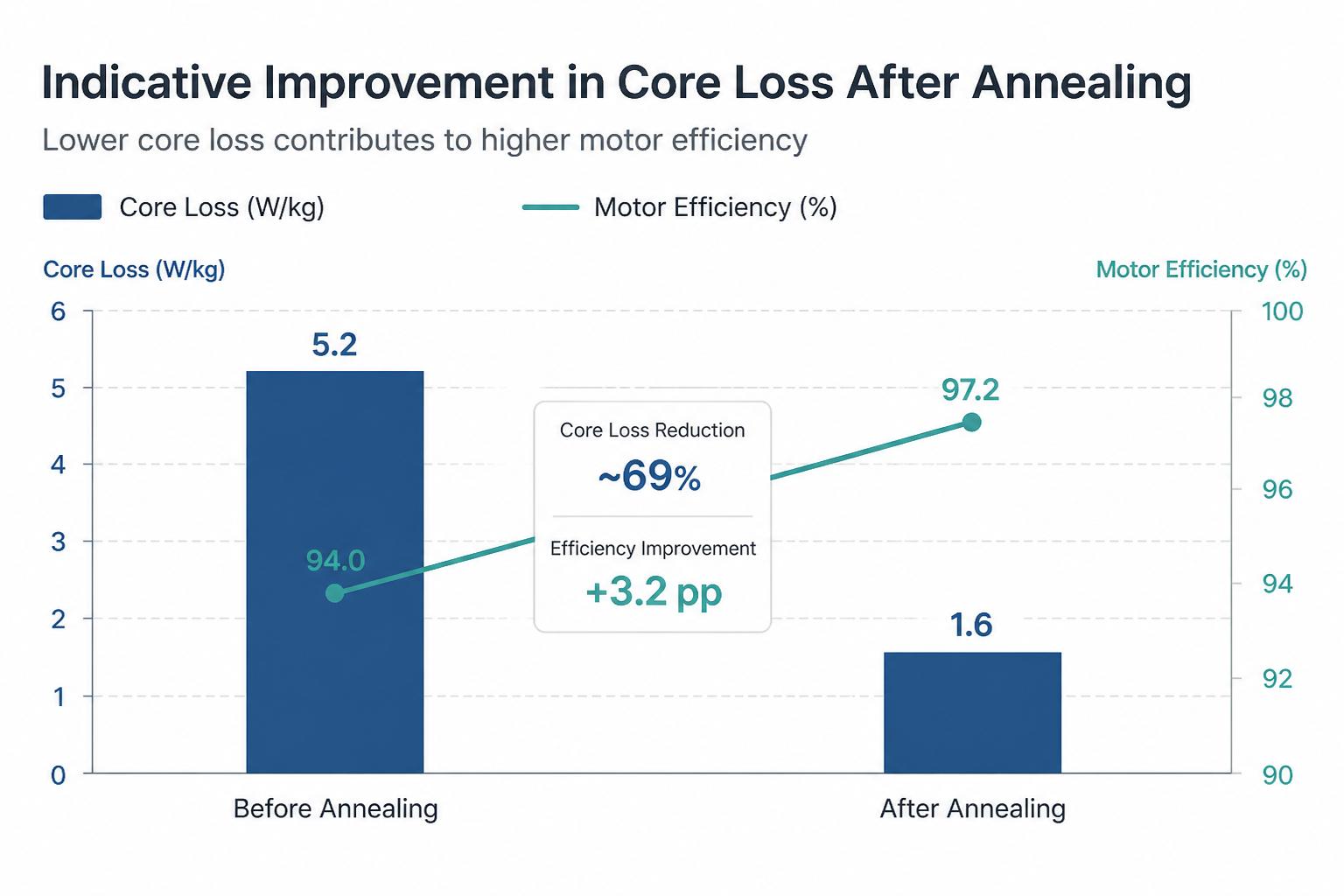
Core losses (hysteresis + eddy current losses) directly impact motor efficiency and temperature rise. Published data for non‑oriented electrical steels show that improper processing can increase core losses by 20–50 % compared to the mill’s reference values.
By using controlled annealing services, OEMs typically see:
Core loss values returning close to the original steel specification
1–3 percentage point improvement in motor efficiency for many small and medium motors
Lower operating temperatures, which extend insulation and bearing life
For appliance and HVAC manufacturers producing high volumes, even a 0.5–1 % efficiency improvement multiplied across millions of units is a major energy and cost saving for end users.
2. Lower noise and vibration
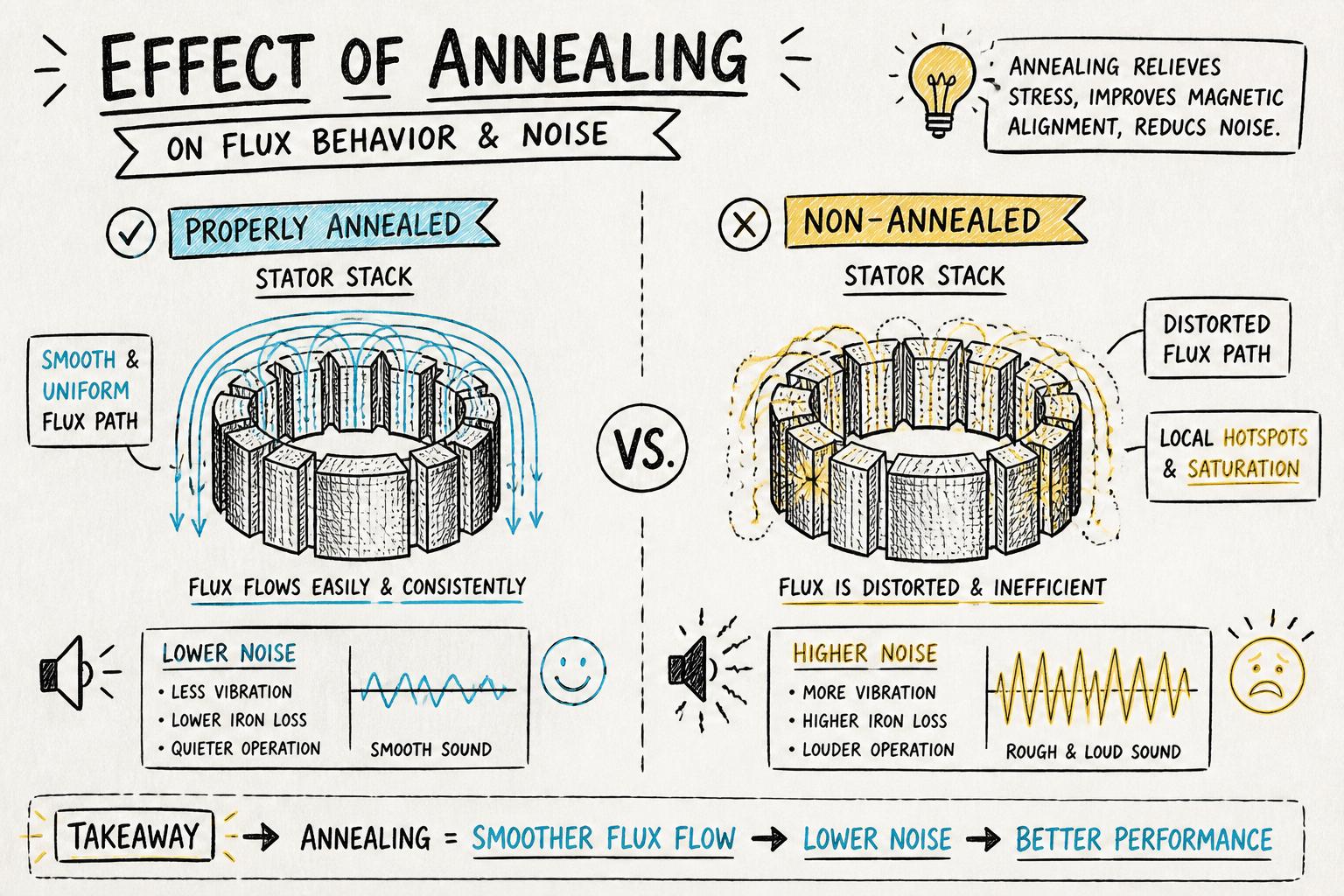
Mechanical stresses and uneven magnetization in non‑annealed laminations can cause local magnetostriction, leading to vibration and audible noise. This is particularly noticeable in household appliances and HVAC equipment where acoustic comfort matters.
Annealed laminations exhibit smoother flux paths and more uniform magnetization, which reduces magnetic forces that excite stator and frame structures.
Without heat treatment, the amount of stamping‑induced damage can vary with tool wear, press settings, and material batches. That translates into variation in no‑load current, power factor, efficiency, and noise from batch to batch.
With a well‑controlled electrical steel heat treatment process, these variations are significantly reduced. For OEMs, that means:
Tighter control of design targets (efficiency classes, temperature rise, noise limits)
Smoother production testing and fewer out‑of‑spec units
More predictable field performance and warranty behavior
Typical annealing process for motor laminations
While exact cycles depend on the steel grade and component design, a typical process for annealing motor laminations includes:
1. Preparation and loading
Cleaning laminations or stacks to remove oil, contaminants, and loose burrs
Loading into fixtures, baskets, or trays to maintain flatness and spacing
Ensuring correct orientation and support to avoid distortion during heating
2. Controlled atmosphere
Annealing is usually done in a protective atmosphere furnace (e.g., nitrogen, hydrogen‑based, or mixed atmosphere) to:
Prevent surface oxidation and scaling
Protect or re‑form the interlaminar insulation coating
Minimize carbon pickup or decarburization
For many modern electrical steels, furnace atmosphere and dew point must be controlled within tight limits recommended by the steel producer.
3. Heating and soaking
The laminations are then heated at a controlled rate to the target annealing temperature, typically in the range specified by the steel manufacturer. Key considerations:
Uniform temperature across the load to avoid differential expansion and distortion
Soaking time sufficient to allow stress relief and grain growth through the entire stack
Temperature accuracy verified by calibrated thermocouples and regular furnace surveys
4. Controlled cooling
Cooling rate is as important as heating. Too fast, and new stresses can be introduced; too slow, and throughput suffers. Controlled, uniform cooling within the protective atmosphere helps:
Maintain the desired microstructure
Prevent warping, twisting, or stack separation
Preserve surface finish and insulation properties
How annealing affects insulation coatings
Modern electrical steels are supplied with various insulation coatings (C‑2, C‑3, organic, inorganic, hybrid types), each with a maximum recommended continuous and peak temperature.
Annealing above these limits or in the wrong atmosphere can:
Degrade or burn off the coating, increasing interlaminar eddy currents
Change the coating’s dielectric properties
Cause discoloration and surface roughness
That is why experienced suppliers design the annealing cycle around both the steel grade and the coating type, often following the steel producer’s processing recommendations and validating results with test laminations.
For background on coating types and limits, it is useful to review data sheets from major electrical steel manufacturers and industry standards such as IEC 60404 for magnetic materials.
Measuring the effect: Epstein test annealed laminations
To quantify the impact of annealing, many quality‑focused suppliers use Epstein testing on both as‑stamped and annealed samples. The Epstein frame test (as defined in IEC/ISO standards for Epstein test methods) measures:
By comparing Epstein test annealed laminations to the original coil data, OEMs can verify that the supplier’s stamping and heat treatment process is not degrading the material beyond acceptable limits.
In addition, some manufacturers correlate Epstein results with finished stator testing (no‑load current, stray load loss, temperature rise) to build a robust process control loop.
What OEMs should specify for annealed laminations
To get consistent, high‑performance motor components, OEMs should move beyond generic “annealed lamination” requests and specify clear, verifiable requirements. Typical elements include:
1. Material and core loss targets
Steel grade (e.g., M‑47, 50A600, or equivalent non‑oriented grade)
Thickness (e.g., 0.35 mm, 0.5 mm)
Maximum allowable core loss after stamping and annealing, referenced to a test standard (e.g., W/kg at 1.5 T, 50/60 Hz)
2. Heat treatment process expectations
Requirement for controlled atmosphere annealing suitable for the chosen steel and coating
Confirmation that furnace temperature control and monitoring meet agreed tolerances
Specification of whether annealing is done on loose laminations, sub‑stacks, or fully assembled stator stacks
3. Testing and documentation
Routine or periodic Epstein core loss tests on representative samples
Finished stator tests (e.g., no‑load current, winding resistance, surge test for die‑cast rotors) as applicable
Certificates of conformity summarizing material heat, coating type, and test results
4. Dimensional and visual requirements
Flatness and run‑out limits for laminations and stator stacks
Maximum allowable burr height after stamping and annealing
Surface appearance and discoloration limits
When is annealing essential vs optional?
Not every motor design or application needs the same level of post‑stamping heat treatment. In practice:
High‑efficiency motors (IE2, IE3, and above) almost always benefit from carefully controlled annealing to achieve design targets.
Motors operating continuously at high load or temperature (pumps, compressors, HVAC blowers) gain from lower core losses and reduced temperature rise.
Noise‑sensitive applications (household appliances, premium fans, air conditioners) see tangible benefits in acoustic performance.
Very small, low‑cost motors for non‑critical applications may accept non‑annealed laminations if the design accounts for higher losses.
For OEMs targeting premium energy labels or long warranty periods, annealing is rarely optional; it is part of the core design and manufacturing strategy.
Common pitfalls in annealing motor laminations
Even when annealing is specified, results can vary widely depending on process control. Typical pitfalls include:
Inadequate atmosphere control, leading to oxidation or coating damage
Non‑uniform temperature within the furnace, causing variation between parts in the same batch
Over‑ or under‑annealing due to incorrect time/temperature cycles
Poor loading practice that causes distortion or uneven heating
Insufficient testing, so degradation is only discovered at the finished motor stage
Working with a supplier that combines precision stamping, controlled annealing, and in‑house testing significantly reduces these risks.
ASA Industries integrates stamping, heat treatment, and testing to deliver consistent, high‑performance motor laminations and stacks for appliance, HVAC, automotive, and industrial OEMs.
Precision lamination stamping on high‑tonnage presses (125–360 Ton) with progressive tooling to minimize edge damage and burrs.
State‑of‑the‑art annealing services with controlled furnace temperature and atmosphere, tailored to specific electrical steel grades and coatings.
Epstein testing of stamped and annealed laminations to verify core loss and magnetic properties against material specifications.
Stator and rotor component testing, including surge testing for die‑cast rotors, to ensure system‑level performance.
ISO‑certified quality systems with SPC, incoming and final inspection, and traceable documentation for OEM audits.
Because tooling design, stamping, annealing, and testing are all under one roof, process parameters can be tuned quickly to meet your specific motor design targets.
Questions to ask your lamination supplier
If you are reviewing or qualifying suppliers for annealed laminations, some practical questions include:
Which electrical steel grades and coatings do you routinely process, and what annealing cycles do you use for them?
Is annealing done in‑house or outsourced? How do you control furnace atmosphere, temperature, and loading?
Do you perform Epstein tests or other magnetic property measurements on a routine basis?
How do you correlate lamination test results with finished motor performance for your customers?
What documentation and traceability can you provide for each batch?
Clear answers to these questions are strong indicators of a partner capable of supporting high‑efficiency, low‑loss motor programs.
Summary: why annealing motor laminations matters
For OEMs, the key takeaways on annealing motor laminations are:
Stamping inevitably degrades the magnetic properties of electrical steel; annealing is the proven way to restore performance.
Properly annealed laminations reduce core loss, improve efficiency, lower noise, and increase reliability.
Well‑specified heat treatment and testing requirements are essential to get consistent results from suppliers.
Integrated stamping, annealing, and testing—backed by standards such as IEC 60404 and Epstein test methods—provide the strongest assurance of performance.
If you are developing or upgrading motors for appliances, HVAC, or industrial applications and want to tighten control over lamination performance, partnering with a manufacturer that combines precision stamping, advanced annealing services, and rigorous testing can help you achieve your efficiency and reliability targets with confidence.