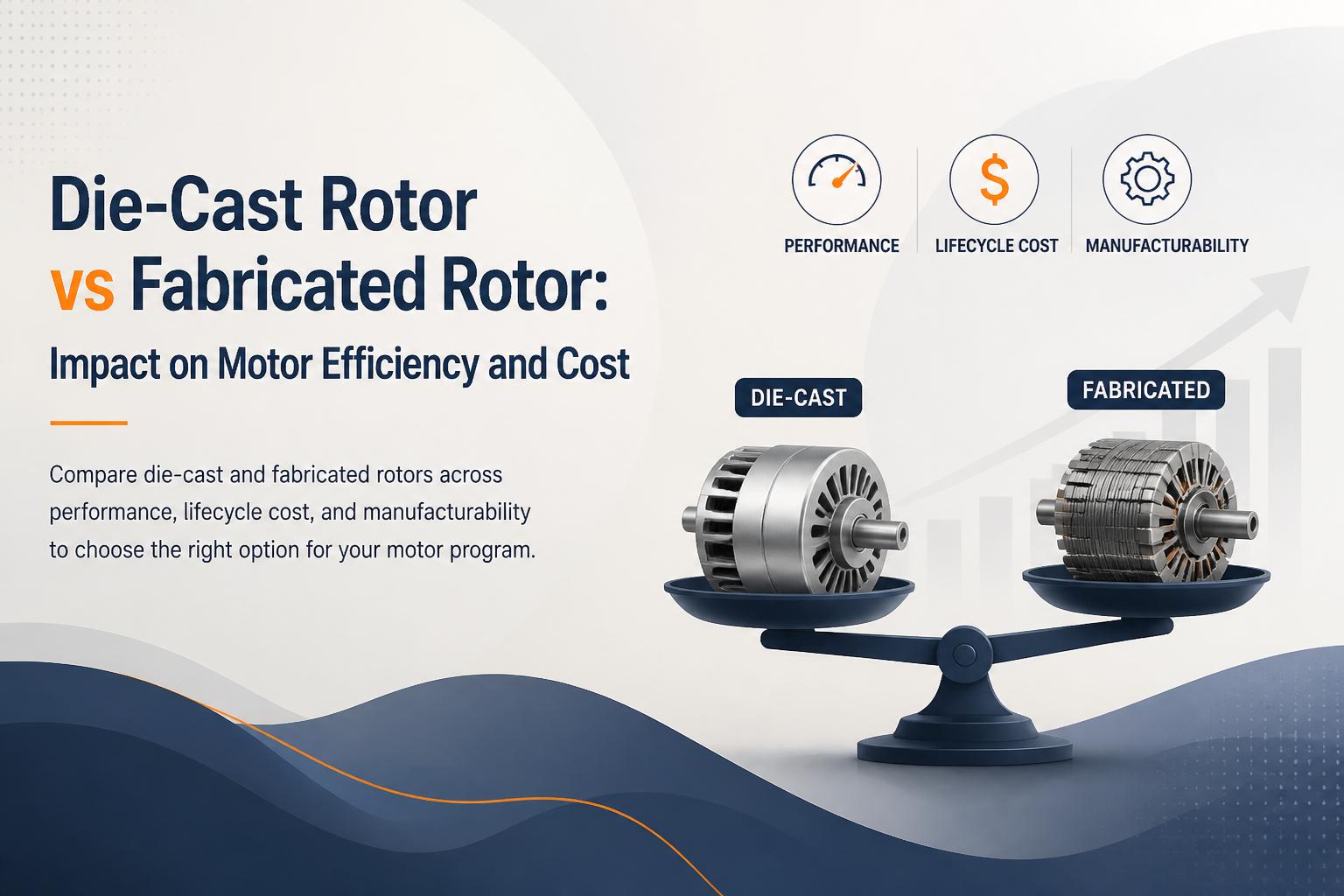
If you are choosing between a die cast rotor and a fabricated rotor for a new motor platform, you are really deciding how you will balance efficiency, cost, and manufacturability over the next decade of production – not just on day one of SOP.
In this comparison guide, we will break down how die-cast and fabricated rotors differ in electromagnetic performance, mechanical robustness, tooling and piece-part cost, and supply chain risk, so you can align rotor design with your motor’s efficiency targets and volume strategy. For a deeper dive into casting capabilities and constraints, see our detailed guide on aluminium die casting for electric motor rotors and housings.
The analysis here is written for OEM engineering, sourcing, and program teams who need to make a defensible choice that will survive design reviews, cost-down rounds, and field performance over the full lifecycle of the motor.
What is a die-cast rotor?
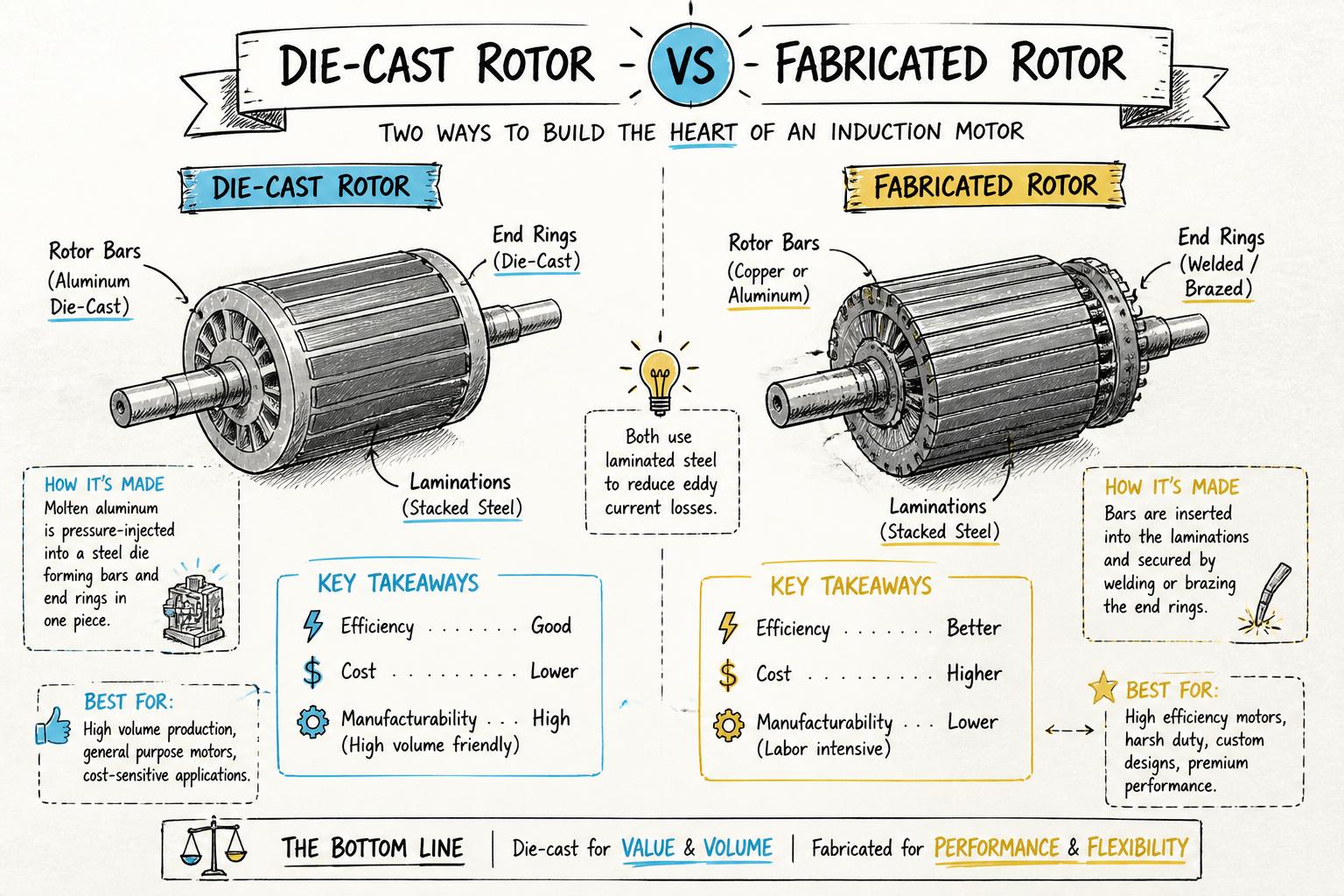
A die-cast rotor is a squirrel-cage rotor where the rotor bars and end rings are formed in a single aluminium die casting operation directly into the rotor and stator laminations stack. Molten aluminium is injected under pressure into the die, filling the bar slots and forming the end rings in one shot.
This process is widely used for single phase induction motors, shaded pole motors, and many appliance and HVAC motors because it offers a strong combination of repeatability, low piece-part cost at volume, and good electromagnetic performance. As discussed in our article on die casting quality controls, modern foundries combine process control, X-ray/sectioning, and surge testing to keep porosity and defects within tight limits.
Key features of die-cast rotors
Integrated rotor cage – bars and end rings cast as a single piece.
High-volume capability – aluminium die casting cells can support hundreds of thousands of rotors per year.
Good thermal path – aluminium cage conducts heat from rotor bars to the end rings and shaft area.
Stable performance – minimal variation between parts when tooling and process are well controlled.
What is a fabricated rotor?
A fabricated rotor (sometimes called a bar-and-ring rotor) is built by inserting individually manufactured conductive bars (usually copper or aluminium) into the rotor lamination slots and then joining separate end rings by brazing, welding, or high-pressure processes.
This method is more common in larger industrial motors and some high-efficiency designs where copper bars can deliver lower I²R losses than aluminium. Because each bar and joint is made and assembled separately, fabricated rotors can be tuned for specific performance, but at the cost of more complex manufacturing.
Key features of fabricated rotors
Discrete bars and end rings – assembled and joined after lamination stack-up.
Material flexibility – easy to use copper bars, special alloys, or mixed geometries.
Higher labour content – more manual or semi-automated operations.
Suited to lower volumes or very high power – where tooling cost is harder to amortise or copper’s benefits dominate.
Die-cast rotor vs fabricated rotor: side-by-side comparison
The table below summarises the main trade-offs between die-cast and fabricated rotors for typical appliance and light industrial motor applications.
Performance and cost comparison
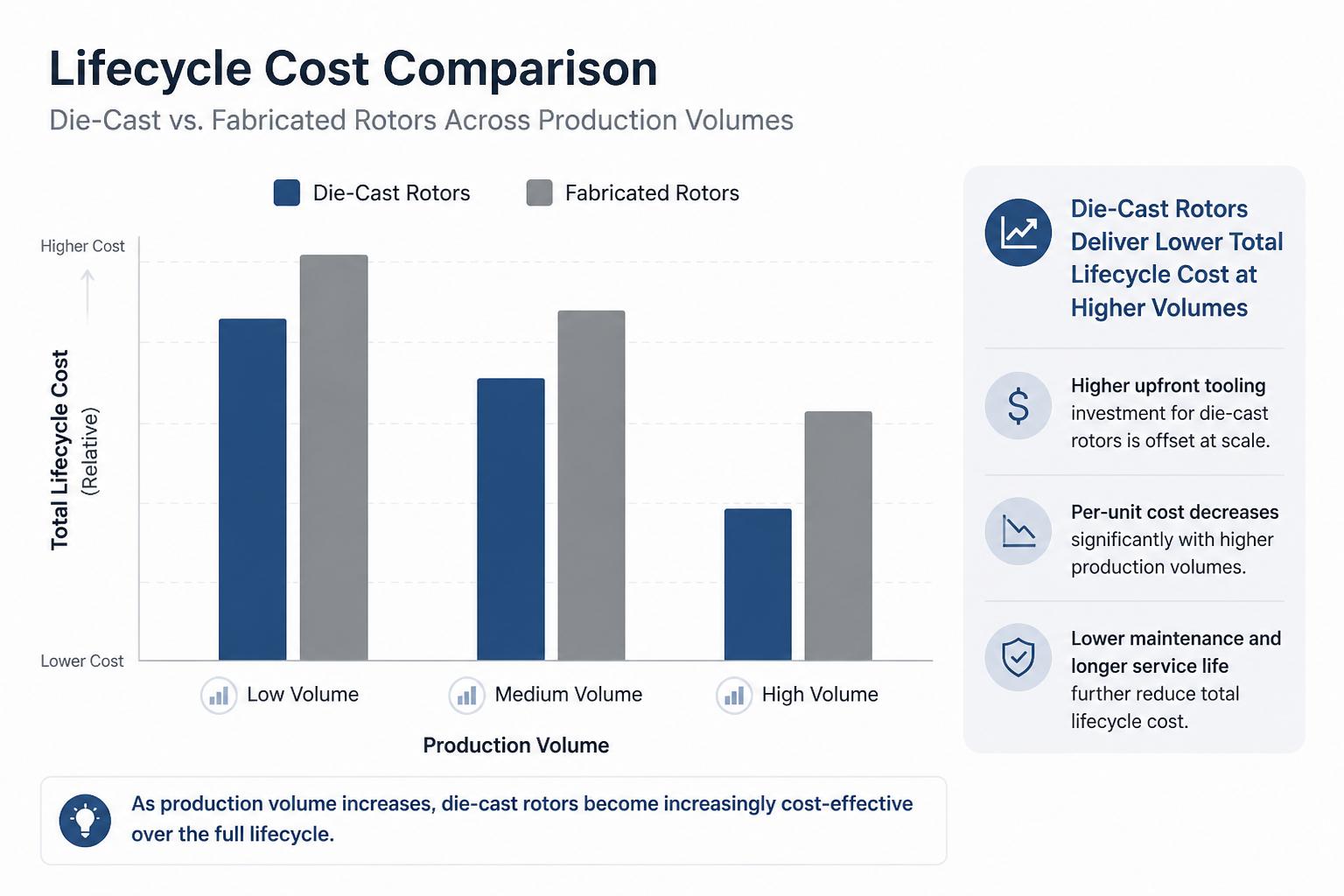
Electromagnetic efficiency – fabricated copper-rotor designs can achieve slightly higher peak efficiency, but a well-designed aluminium die cast rotor is often within a few percentage points while being significantly cheaper at volume.
Starting torque and slip – both technologies can be engineered for high starting torque; rotor bar geometry and material selection are the main levers.
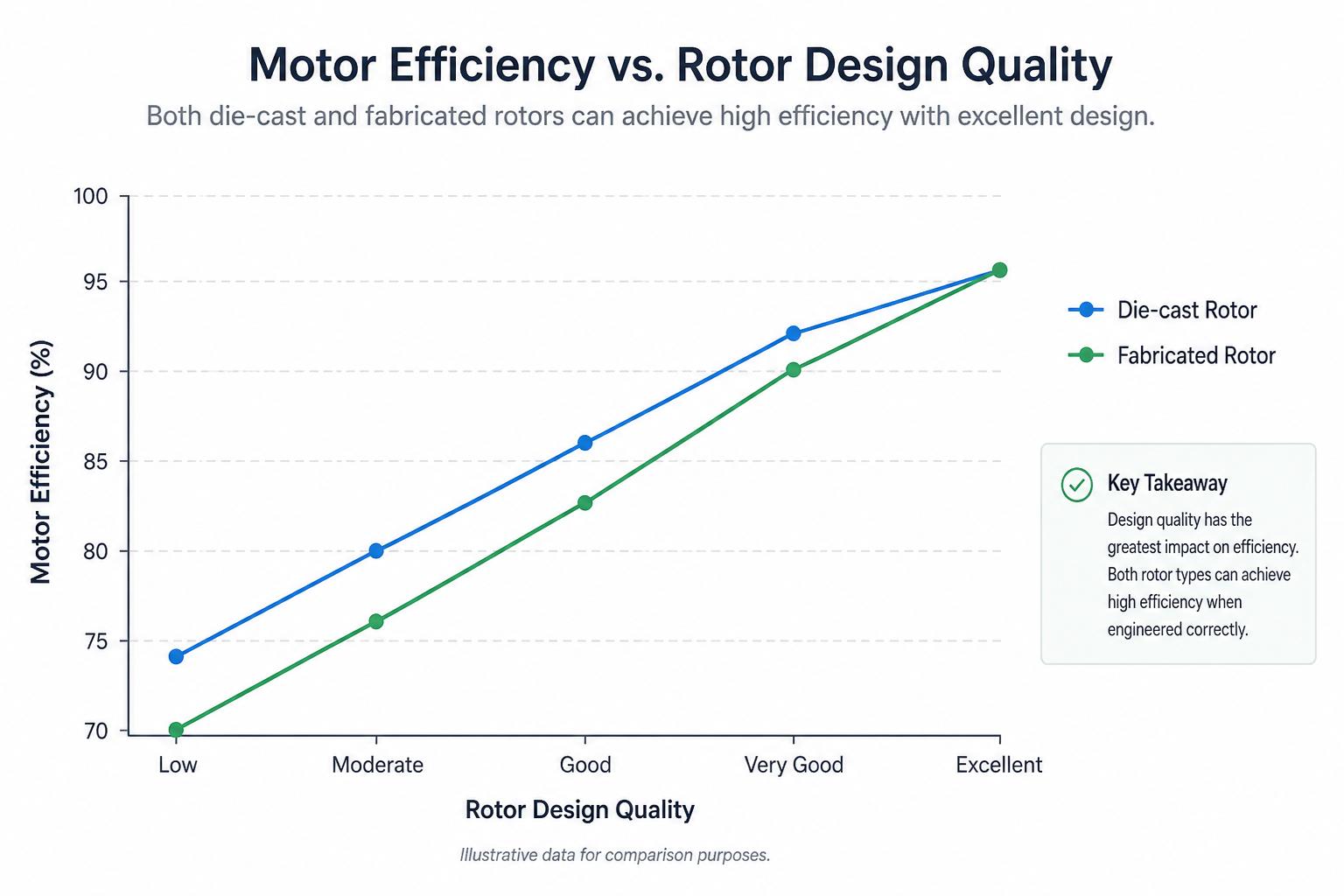
Lifecycle cost – die-cast rotors generally win at medium-to-high volume because lower piece-part and assembly costs outweigh marginal efficiency differences.
Tooling and change management – fabricated rotors can be modified with less tooling change, but every design variant adds assembly complexity. Die casting requires up-front tooling investment but enables stable, automated production once frozen.
Impact on motor efficiency
Motor efficiency is strongly influenced by rotor design, materials, and manufacturing quality. Whether you choose die-cast or fabricated, you can achieve good results – but the path is different.
Conductor material and I²R losses
Copper has roughly 60% higher electrical conductivity than aluminium, which means that, for the same geometry, a copper bar rotor will have lower I²R losses and therefore higher efficiency.
However, in many appliance and HVAC motors, you can compensate for aluminium’s higher resistivity by adjusting bar cross-section, slot geometry, and rotor and stator laminations design. A carefully optimised aluminium die cast rotor can reach efficiency levels very close to a copper fabricated rotor, especially in small-to-medium frame sizes.
Rotor design and leakage reactance
Rotor bar shape, depth, and skew directly affect leakage reactance, starting torque, and breakdown torque. With die casting, you have a high degree of freedom to design complex bar shapes that are consistently reproduced in production. This is particularly useful when coordinating rotor and stator laminations to meet aggressive efficiency targets.
Fabricated rotors also allow sophisticated bar profiles, but manufacturing tolerances and assembly variation can introduce more spread in performance, especially when multiple suppliers are involved for bars, rings, and assembly.
Thermal behaviour
Both die-cast and fabricated rotors rely on the end rings and shaft to remove heat from the rotor cage. Aluminium’s higher thermal conductivity can be beneficial in die-cast rotors, helping to spread heat quickly across the cage.
In high-power or continuous-duty applications, copper’s lower electrical losses often dominate the thermal picture, making fabricated copper rotors attractive. For small motors operating intermittently (fans, pumps, compressors in appliances), aluminium die cast rotors typically provide sufficient thermal performance at lower cost.
Impact on motor cost and lifecycle economics
For OEMs, the most important question is rarely “Which rotor is theoretically more efficient?” but rather “Which solution minimises total cost over the program life while meeting performance and regulatory requirements?”
Tooling and development cost
Die-cast rotor – requires dedicated die casting tooling and often specific fixtures for surge testing and machining. Up-front tooling cost is higher, but amortised over large volumes it becomes negligible per piece.
Fabricated rotor – lower casting tooling cost, but you need tooling for bar production, ring forming, brazing/welding fixtures, and often more complex gauges and jigs for quality control.
If your program volume is expected to be tens or hundreds of thousands of motors per year, the economics almost always favour the die cast rotor, especially when combined with an integrated stamping and casting supply chain as described in our article on integrating stamping, die casting, and machining in your motor component supply chain.
Piece-part and assembly cost
Material cost – aluminium is significantly cheaper than copper and less volatile in price, which stabilises BOM cost for die-cast rotors.
Labour and automation – die casting can be highly automated, with minimal manual handling; fabricated rotors often involve more human labour or complex automation.
Scrap and rework – well-controlled die casting processes with robust quality controls (dimensional checks, X-ray, surge testing) tend to have predictable scrap rates. Fabricated assemblies may see higher variation due to joint quality and assembly defects.
When you model lifecycle cost – including tooling, material, labour, scrap, and quality costs – die-cast rotors typically provide the lowest cost per kWh delivered for high-volume appliance and HVAC applications.
Manufacturability and supply chain considerations
Rotor manufacturing method directly affects how complex your supply chain will be and how easily you can scale or localise production.
Process integration
Die-cast rotors are a natural fit for vertically integrated setups that combine lamination stamping, rotor stacking, aluminium rotor casting, CNC turning, and surge testing under one roof. This reduces logistics, WIP, and quality handoffs. Our overview of tooling design for stamping and die casting explains how early coordination between design and tooling teams can unlock these efficiencies.
Fabricated rotors, by contrast, often involve multiple specialised suppliers: one for laminations, one for copper bars, one for rings, and another for assembly and brazing. This increases coordination effort and risk of mismatch between design intent and manufacturing reality.
Quality control and consistency
With die-cast rotors, the main risks are porosity, incomplete fill, or dimensional variation from tooling wear. Modern die casting manufacturers manage these through:
Robust die design and maintenance programmes.
Statistical process control (SPC) on key casting parameters.
Routine visual and dimensional inspection.
Electrical tests such as surge testing to detect hidden defects in the rotor cage.
Fabricated rotors introduce additional failure modes: poor brazed joints, bar misalignment, inconsistent ring shrink-fit, and residual stresses from welding. Each adds to inspection complexity and potential field failure mechanisms if not tightly controlled.
When to choose a die-cast rotor
Based on experience with appliance and light industrial OEMs, a die cast rotor is usually the right choice when:
Annual volumes are medium to high (e.g., >20,000 motors/year per variant).
Motor frame sizes are small to medium (typical for fans, pumps, compressors, and household appliances).
Efficiency targets are demanding but achievable with aluminium, often in line with regional appliance efficiency regulations.
Cost competitiveness is critical in a crowded market segment.
Supply chain simplicity and repeatability are priorities, especially when sourcing from a single integrated manufacturer.
For example, many single phase induction motors used in refrigerators, washing machines, and air conditioners rely on aluminium die cast rotors to balance performance and cost. Studies of high-efficiency motor designs show that optimised aluminium rotors can meet stringent efficiency classes when combined with high-quality laminations and proper annealing.
When to choose a fabricated rotor
Fabricated rotors, especially copper-bar designs, remain the best option when:
Power levels are high and losses must be minimised to manage heat and operating cost.
Efficiency is the overriding priority, for example in premium industrial motors operating 24/7 where even a 1–2% efficiency gain has a strong payback.
Annual volumes are relatively low, making it harder to justify die casting tooling.
Design flexibility and frequent iteration are expected over the product life.
In such cases, the higher material and assembly cost of fabricated rotors can be offset by reduced energy consumption in the field. The International Energy Agency notes that electric motors account for a significant share of industrial electricity use, so small gains in efficiency at scale can be economically meaningful.
Designing for manufacturability: practical tips
Whichever rotor type you choose, early attention to manufacturability will reduce risk and cost. Some practical guidelines include:
Coordinate rotor and stator laminations
Design slot geometry with both electromagnetic and stamping constraints in mind – avoid extremely thin webs that are difficult to stamp consistently.
Consider how skew and stack height will be achieved in production – progressive die stamping and stacking tooling should be discussed with your supplier early.
Our article on aluminium die casting for electric motor rotors explains how lamination design interacts with casting flow and solidification.
Plan for testing and quality assurance
Specify appropriate surge testing and electrical checks for die-cast rotors to detect broken bars or casting defects before assembly.
For fabricated rotors, define requirements for joint inspection (e.g., visual, dye penetrant, or other NDT methods) and torque tests on end rings if applicable.
Ensure that stator cores receive proper annealing and magnetic testing (e.g., Epstein testing) to minimise core losses and complement rotor efficiency.
For a structured overview of quality checks from tooling through to finished components, see our guide on quality controls in die casting.
How ASA Industries supports your rotor decision
ASA Industries specialises in electrical stamping, lamination stacks, and aluminium die cast rotor manufacturing for appliance and industrial OEMs. With integrated capabilities – including progressive die stamping, annealing, aluminium die casting (80–250 ton), CNC turning, and surge testing – we help engineering teams translate rotor designs into stable, scalable production.
By engaging early in your rotor design process, we can:
Review rotor and stator lamination drawings for manufacturability.
Advise on when a die cast rotor will deliver the best balance of efficiency and cost for your specific duty cycle and volume.
Estimate tooling and piece-part costs under different volume and localisation scenarios.
Set up appropriate quality plans, including surge testing and dimensional control, to protect field performance.
Next steps: choosing the right rotor for your motor program
Summarising the comparison:
Die-cast rotors – best choice for high-volume, small-to-medium motors where cost, manufacturability, and robust performance matter most.
Fabricated rotors – suited to lower-volume, high-power, or ultra-high-efficiency motors where copper’s performance advantages justify higher cost and complexity.
If your motor program fits the typical appliance or HVAC profile – medium-to-high volumes, competitive pricing pressure, and demanding but achievable efficiency targets – an aluminium die cast rotor designed with manufacturability in mind will almost always provide the most attractive lifecycle economics.
To explore how a die cast rotor could fit into your next motor platform, or to review your existing rotor design for cost and manufacturability improvements, reach out to ASA Industries for a technical discussion with our engineering team.